Detail Berita
SmartMedGuard: A Smart Way to Monitor Inpatient Rooms Using IoT Technology
Isi Artikel
Digital transformation in the healthcare sector has become one of Indonesia’s national priorities, in line with the growing demand for fast, accurate, and data-driven public services. However, many primary healthcare facilities such as community health centers (puskesmas) and Class C/D hospitals still face challenges in managing service rooms. Temperature, humidity, and occupancy records in inpatient rooms are often maintained manually—or not properly documented at allslowing down decision-making processes, particularly during emergencies or patient surges.
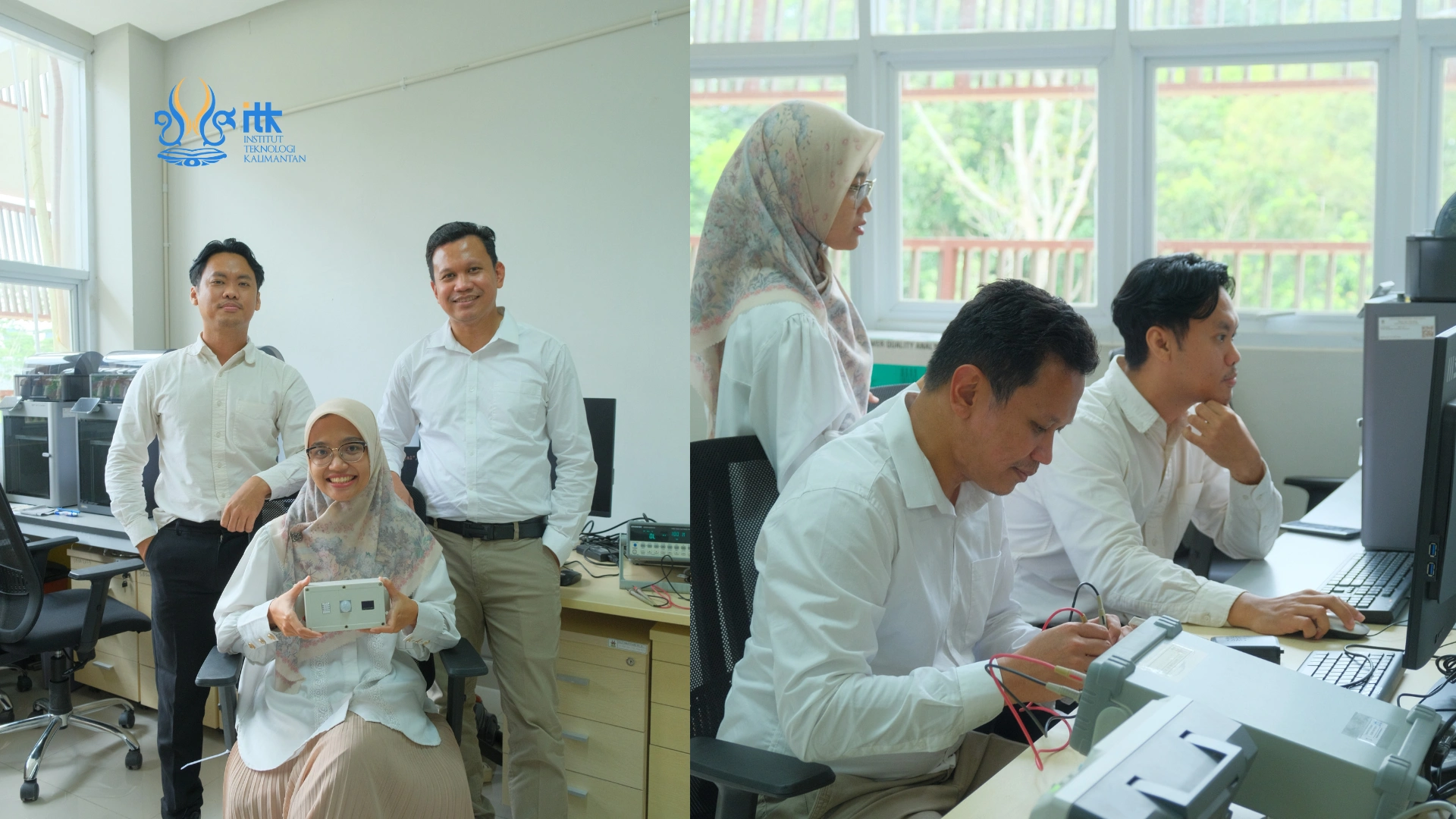
In response to these challenges, an interdisciplinary research team led by Ir. Oryza Lhara Sari, M.T., together with Adi Mahmud Jaya Marindra, Ph.D., and Maryo Inri Pratama, M.T., along with two students—Muhammad Ridhoi Mahbubi (Electrical Engineering) and Rizky Irswanda Ramadhana (Informatics)—developed SmartMedGuard, an Internet of Things (IoT)-based inpatient room monitoring system designed to be modular, energy-efficient, and capable of operating without internet dependency.
This innovation supports Pillar 6 of the National Health System Transformation, particularly in strengthening data-driven healthcare services in the buffer zones of Indonesia’s new capital city (IKN).
Why Is Inpatient Room Monitoring Still a Challenge?
The absence of data-driven monitoring systems in healthcare facilities remains a major barrier to improving operational efficiency and emergency preparedness. In many community health centers and Class C/D public hospitals, environmental information such as temperature, humidity, and room occupancy is not yet integrated into an easily accessible real-time system. This situation may affect patient comfort, service effectiveness, and healthcare workers’ responsiveness to changing conditions.
IoT technology offers a practical solution through automated sensor-based monitoring and visual dashboards. With this approach, environmental data can be collected, processed, and displayed instantly, enabling faster and more accurate decision-making. SmartMedGuard represents a concrete implementation of this approach, tailored to the needs and limitations of primary healthcare facilities in Indonesia.
What Does SmartMedGuard Aim to Achieve?
The development of SmartMedGuard aims to build a fully functional inpatient room monitoring prototype that can be tested in a laboratory environment and achieve Technology Readiness Level (TRL) 4.
Specifically, the objectives include:
- Assembling active sensors for monitoring temperature, humidity, and room occupancy
- Developing a visual dashboard based on a local network
- Simulating system integration in inpatient room scenarios
- Evaluating system performance in terms of accuracy, data readability, response speed, and user-friendliness
System Overview: How It Works
SmartMedGuard is designed with a simple yet reliable architecture. The system utilizes:
- DHT22 sensors for temperature (0–80°C) and humidity (0–100% RH) measurements
- PIR sensors with a detection range of up to 6 meters to detect human presence as an occupancy indicator
- ESP32 microcontroller for initial sensor data processing
- Raspberry Pi 5 as a local server for data storage and web dashboard hosting
- An HTML and JavaScript-based dashboard accessible via a local network browser without requiring internet connectivity
The prototype can simultaneously monitor up to five inpatient rooms, operates at 5V 3A power, and includes a mini UPS option that allows the system to continue running for up to two hours during power outages. This approach makes SmartMedGuard a fast, private, and infrastructure-appropriate solution for regional healthcare facilities.
Key Achievements
The development results indicate that the SmartMedGuard prototype is fully functional and integrated. The main outputs include:
- A functional IoT-based inpatient room monitoring prototype
- Comprehensive technical documentation, including system architecture blueprints, hardware and software specifications, and data flow schemes
- System testing reports and a demonstration video
Through these achievements, SmartMedGuard’s Technology Readiness Level has increased from TRL 3 to TRL 4, indicating that the system has been validated in a laboratory environment and is ready for pilot testing in partner healthcare facilities.
Isi Artikel
Berita Terpopuler
Research and Community Service


Tags
Inovation ResearchTags
Inovation ResearchBerita Terpopuler
Research and Community Service
Berita Terbaru
 Diktisaintek Berdampak
Rifkihadi Rahmatullah Joins Ekspedisi Patriot, Bringing Stories of Service from Transmigration Areas
 Announcement
Re-registration for New Students Accepted Through the 2026 National Selection Based on Test (SNBT)
 News
News
ITK Encourages Awareness of Mental Health and Prevention of Non-Communicable Diseases on Campus
ITK Holds Mental Health Seminar to Promote a Healthier Campus Environment