Detail Berita
ITK Students Innovate Clean Water Solution Through Rainwater Harvesting in Balikpapan
.webp)

Isi Artikel
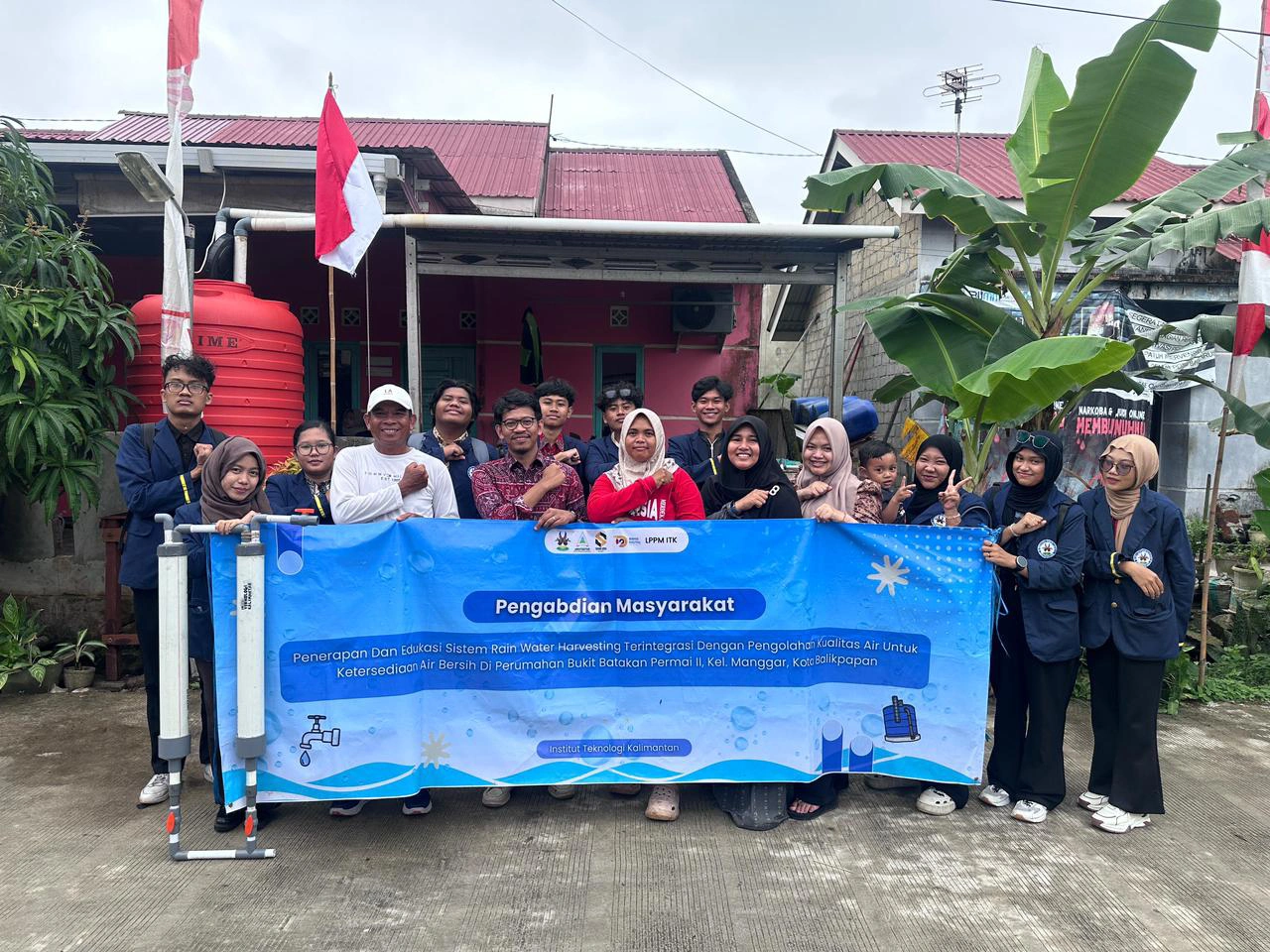
Balikpapan, 2025 — A group of interdisciplinary students from the Institut Teknologi Kalimantan (ITK) has successfully developed a simple yet impactful innovation: a rainwater harvesting and filtration system at Bukit Batakan Permai II Housing Complex in Manggar, Balikpapan.
This project not only provides an alternative source of clean water but also serves as a community education program on sustainable water management.
Rainwater: A Solution Amid Clean Water Scarcity
Access to clean water has become increasingly limited due to climate change and population growth. In Balikpapan, despite its high rainfall, rainwater has not been fully utilized as a potential water source.
Recognizing this, the ITK student team designed a rainwater harvesting system that collects runoff from rooftops and filters it through a simple purification unit, making it suitable for household use.
“We want to show that rainwater can be a real solution to the clean water crisis — as long as it’s managed properly,”
said Afif Taufiiqul Hakim, the team leader from ITK’s Civil Engineering Program.
Energy-Efficient Filtration Design
Before installation, the team conducted a site survey and tested the local water quality. Initial results showed that rainwater in the area had a pH of 7.85 and TDS of 0.162 mg/L, which is considered safe but still requires further treatment to meet the clean water standard (Ministry of Health Regulation No. 2 of 2023).
To address this, the students created a gravity-based filtration system using a combination of silica sand, zeolite stones, activated carbon, and aquarium filter cotton. The system also includes a backwash mechanism, allowing for easy cleaning without disassembly.
“The system is energy-efficient, easy to operate, and can be maintained independently by residents,”
explained Fegy Sukris Sri Andriany from ITK’s Digital Business Program.
Community Training and Enthusiastic Response
Once the system was installed, the ITK team held hands-on training sessions for residents on how to use and maintain the filtration unit. The community responded enthusiastically, with many expressing surprise that rainwater could be turned into clean, usable water.
“We used to collect rainwater in a simple way, but now we know how to make it cleaner and safer,”
said Mrs. Siti, one of the local residents.
Positive Environmental Impact
Follow-up tests showed improved water quality — the pH level decreased to 7.64 and TDS slightly dropped to 0.161 mg/L.
Beyond household use, the system helps reduce dependence on groundwater and minimize flooding and erosion risks caused by excessive rainwater runoff.
Towards a Green and Smart Community
This community service initiative showcases true interdisciplinary collaboration between ITK students from Civil Engineering, Digital Business, and Architecture programs, in support of sustainable urban development.
“We hope this project encourages the public to see water management as a shared responsibility, not just the government’s,”
said Dwi Aneka Kartini, the supervising lecturer.
Moving forward, the ITK team plans to expand the system’s implementation by integrating automatic sensors for real-time water quality monitoring — part of a broader Smart Water Management concept for urban areas.
The program was fully supported by the Institut Teknologi Kalimantan (ITK) through its 2025 Community Service Program, with special appreciation to the residents of Bukit Batakan Permai II for their active participation and collaboration.
Isi Artikel
Berita Terpopuler
Research and Community Service
.webp)
.webp)
Research and Community Service
.webp)
Tags
ActivityTags
ActivityBerita Terpopuler
Research and Community Service
Research and Community Service
Berita Terbaru
.webp) News
News
ITK Holds BMN Write-Off Workshop with KPKNL Balikpapan, Strengthening State Asset Governance
The BMN Write-Off Workshop at ITK featured experts from KPKNL Balikpapan to strengthen understanding and governance of state assets within the university.
.webp) Announcement
Announcement
Timeline for Preparing the Implementation of the 2026 Student Creativity Program (PKM) at ITK
This article provides a comprehensive overview of the 2026 Student Creativity Program (PKM) at ITK, including its schemes, timeline, and participation procedures.
.webp) Scholarship
Scholarship
Information on the 2025 Gratispol Educational Assistance for ITK Students
This information outlines the requirements, criteria, and procedures for ITK students applying for the 2025 Gratispol Educational Assistance Program.